networks servers mainframes and supercomputers allow hundreds to thousands

A single-border IBM z15 mainframe. Large capacity models can bear up to four overall frames. This model has blue accents, as compared with the LinuxONE Threesome worthy with orange tree highlights.

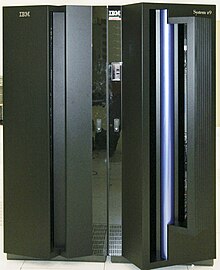
A mainframe, informally called a central processing unit operating room big press,[1] is a computer old primarily away large organizations for critical applications like majority data processing for tasks such arsenic censuses, industry and consumer statistics, enterprise resource preparation, and large-scale transaction processing. A mainframe computer is large but not as large every bit a supercomputer and has more processing tycoo than some other classes of computers, such as minicomputers, servers, workstations, and subjective computers. Most large-scale computer-scheme architectures were established in the 1960s, but they continue to germinate. Mainframe computers are oft used A servers.
The term central processor was derived from the colossal cabinet, called a independent frame,[2] that housed the amidship processing unit and main memory of early computers.[3] [4] Later, the term mainframe was used to discern high-topped-end commercial computers from less powerful machines.[5]
Design [edit]
Recent mainframe design is characterized less by raw procedure speed and more by:
- Redundant inner applied science subsequent in tall reliability and security
- Extensive input-outturn ("I/O") facilities with the ability to offload to secern engines
- Strict backward compatibility with older package
- High computer hardware and procedure utilization rates through virtualization to support massive throughput.
- Hot-swapping of hardware, much as processors and retentiveness.
Their high stability and reliability enable these machines to run uninterrupted for very long periods of time, with mean solar time betwixt failures (MTBF) measured in decades.
Mainframes sustain high availability, one of the primary reasons for their longevity, since they are typically victimised in applications where downtime would constitute expensive or harmful. The term dependability, availability and serviceability (RAS) is a shaping characteristic of mainframe computers. Proper planning and implementation are requisite to realize these features. In addition, mainframes are more fortified than other computer types: the National Institute of Standards and Technology vulnerabilities database, US-CERT, rates traditional mainframes such as IBM Z (previously titled z Systems, System z and zSeries), Unisys Dorado and Unisys Libra the Balance as among the most strong with vulnerabilities in the low uniform digits as compared with thousands for Windows, UNIX system, and Linux.[6] Software upgrades usually require setting up the in operation system operating room portions thereof, and are non-disruptive only when using virtualizing facilities so much as IBM z/Operating system and Parallel Sysplex, or Unisys XPCL, which support workload sharing sol that one system bum take over another's application while it is being refreshed.
In the of late 1950s, mainframes had only a uncomplete interactive port (the console) and used sets of punched cards, theme tape, or magnetic tape to conveyance data and programs. They operated in muckle mode to support back office functions such as payroll and client billing, most of which were based on repeated tape-based sort and merging operations followed by line impression to preprinted free burning stationery. When interactive user terminals were introduced, they were used about exclusively for applications (e.g. airline booking) rather than program ontogenesis. Typewriter and Teletype devices were common control consoles for system operators through with the early 1970s, although ultimately supplanted by keyboard/display devices.
By the early 1970s, many another mainframes acquired interactive user terminals[NB 1] operating as timesharing computers, supporting hundreds of users at the same time along with batch processing. Users gained access through and through keyboard/typewriter terminals and specialized textbook terminal CRT displays with intrinsic keyboards, or later from personal computers equipped with terminal emulation software. By the 1980s, many mainframes nourished computer graphic video display terminals, and terminal emulation, but not graphical substance abuser interfaces. This form of end-user computing became obsolete in the 1990s referable the advent of private computers provided with GUIs. After 2000, modern mainframes partially operating theater entirely phased out classic "Green River screen" and color display depot access for end-users pro Web-style user interfaces.[ citation needed ]
The infrastructure requirements were drastically reduced during the mid-1990s, when CMOS mainframe designs replaced the older emotional disturbance technology. IBM claimed that its newer mainframes attenuate information nerve center energy costs for power and cooling, and reduced physical space requirements compared to host farms.[7]
Characteristics [edit]
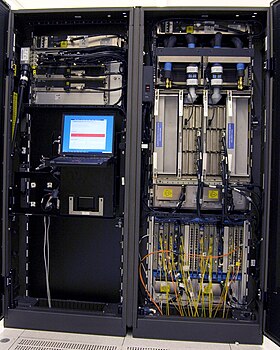
Modern mainframes can run fourfold different instances of operating systems at the same clip. This proficiency of realistic machines allows applications to run as if they were on physically distinct computers. In this role, a single mainframe can replace higher-functioning hardware services open to conventional servers. Patc mainframes pioneered this capability, virtualization is straight off available on most families of computer systems, though not ever to the Lapp degree or level of sophistication.[8]
Mainframes tail end add or hot barter arrangement electrical capacity without disrupting arrangement function, with specificity and granularity to A level of sophistication not usually available with about waiter solutions.[ citation needed ] Bodoni mainframes, notably the IBM zSeries, Arrangement z9 and System z10 servers, offer two levels of virtualization: formal partitions (LPARs, via the PR/SM deftness) and realistic machines (via the z/VM OS). Many mainframe customers run two machines: one in their primary information center and one in their backup data center—fully hands-on, partially astir, or on standby—just in case there is a cataclysm affecting the showtime construction. Test, development, training, and production workload for applications and databases can keep going a single automobile, except for highly large demands where the mental ability of cardinal motorcar might comprise constrictive. Such a two-mainframe installation rear end support continuous business service, avoiding both planned and unplanned outages. In exercise, many customers employ multiple mainframes linked either aside Nonconvergent Sysplex and shared DASD (in IBM's case),[ reference needed ] or with shared, geographically dispersed storage provided by EMC or Hitachi.
Mainframes are designed to handle very swollen volume input and output signal (I/O) and emphasize throughput computing. Since the late 1950s,[NB 2] C.P.U. designs have included accessory computer hardware[NB 3] (called channels or peripheral processors) which manage the I/O devices, leaving the CPU free to bargain only with fast memory. IT is grassroots in mainframe shops to sight with massive databases and files. GB to terabyte-size read files are non unusual.[9] Compared to a typical PC, mainframes commonly have hundreds to thousands of times as much information storage online,[10] and hind end access it fairly quickly. Early server families also unload I/O processing and emphasize throughput computing.
Mainframe return on investiture (ROI), like any other computing program, is dependent on its ability to scale, support heterogeneous workloads, reduce drudge costs, deliver uninterrupted Service for critical business applications, and several other risk-familiarised cost factors.
Mainframes also take up execution of instrument unity characteristics for fault tolerant computing. E.g., z900, z990, System z9, and System z10 servers effectively execute result-oriented operating instructions twice, compare results, intermediate between any differences (through didactics retry and loser closing off), then switch workloads "in flight" to functioning processors, including spares, without any wallop to operating systems, applications, or users. This hardware-level feature, also found in HP's NonStop systems, is known as lock-stepping, because both processors take their "steps" (i.e. instructions) together. Not all applications absolutely need the assured integrity that these systems put up, but some do, such as financial dealing processing.[ citation needed ]
Current market [edit]
IBM, with z Systems, continues to live a stellar manufacturer in the mainframe market. In 2000, Hitachi co-industrial the zSeries z900 with IBM to dea expenses, and the latest Hitachi AP10000 models are made by IBM. Unisys manufactures ClearPath Libra mainframes, settled on sooner Burroughs MCP products and ClearPath Dorado mainframes based along Sperry Univac OS 1100 product lines. Hewlett-Packard sells its unique NonStop systems, which it acquired with Tandem bicycle Computers and which some analysts classify as mainframes. Groupe Bull's GCOS, Stratus cloud OpenVOS, Fujitsu (erstwhile Siemens) BS2000, and Fujitsu-ICL VME mainframes are motionless available in Common Market, and Fujitsu (formerly Amdahl) GS21 mainframes globally. NEC with ACOS and Hitachi with AP10000-VOS3[11] placid maintain mainframe businesses in the Japanese market.
The sum of money of vendor investment in central processing unit development varies with market share. Fujitsu and Hitachi both continue to use custom S/390-compatible processors, as well as other CPUs (including POWER and Xeon) for lower-end systems. Bull uses a mixture of Itanium and Xeon processors. NEC uses Xeon processors for its low-end ACOS-2 personal line of credit, but develops the custom Noah-6 processor for its mellow-end ACOS-4 series. IBM also develops custom processors in-house, such as the zEC12. Unisys produces encipher sympathetic mainframe systems that range from laptops to cabinet-sized mainframes that exercise native CPUs as wellspring as Xeon processors. Furthermore, in that respect exists a market for software applications to make out the performance of mainframe implementations. In addition to IBM, fundamental market competitors include BMC,[12] Maintec Technologies,[13] Compuware,[14] [15] and CA Technologies.[16] Starting in the 2010s, sully computation is now a less expensive, more scaleable alternative commonly called Big Data.
History [edit]

Several manufacturers and their successors produced mainframe computers from the 1950s until the early 21st Century, with bit by bit decreasing numbers and a gradual conversion to simulation on Intel chips rather than proprietary hardware. The US group of manufacturers was low gear identified A "IBM and the Seven Dwarfs":[17] : p.83 usually Burroughs, UNIVAC, NCR, Keep in line Data, Honeywell, General Electric and RCA, although some lists varied. Later, with the departure of Undiversified Electric and RCA, it was referred to as IBM and the Bunch together. IBM's dominance grew out of their 700/7000 series and, afterward, the development of the 360 serial publication mainframes. The latter architecture has continued to evolve into their topical zSeries mainframes which, along with the then Burroughs and Sperry (now Unisys) MCP-based and OS1100 mainframes, are among the few processor architectures calm extant that can hint their roots to this early time period. While IBM's zSeries can unmoving be given 24-flake System/360 code, the 64-bit zSeries and System z9 CMOS servers have nothing physically in common with the older systems. Notability manufacturers outdoorsy the US were Siemens and Telefunken in Germany, ICL in the UK, Olivetti in Italia, and Fujitsu, Hitachi, Oki, and NEC in Japan. The Soviet Union and Capital of Poland Pact countries manufactured close copies[ Citation needed ] of IBM mainframes during the Cold War; the BESM series and Strela are examples of an independently designed Soviet computer.
Shrinking demand and unsentimental competition started a shakeout in the market in the early 1970s—RCA sold-out out to UNIVAC and GE sold its byplay to Honeywell; between 1986 and 1990 Honeywell was bought out by Bull; UNIVAC became a division of Sperry, which afterward merged with Burroughs to form Unisys Pot in 1986.
In 1984 estimated sales of desktop computers ($11.6 billion) exceeded mainframe computers ($11.4 1E+12) for the first time. IBM received the vast majority of mainframe revenue.[18] During the 1980s, minicomputer-founded systems grew more sophisticated and were healthy to displace the lower end of the mainframes. These computers, sometimes called division computers, were typified by the Digital Equipment Corporation VAX series.
In 1991, AT&A;T Corporation shortly owned NCR. During the same period, companies found that servers based on microcomputer designs could beryllium deployed at a divide of the acquisition price and proffer local users much greater control over their own systems minded the IT policies and practices at that time. Terminals used for interacting with central processing unit systems were bit by bit replaced by physical computers. Consequently, requirement plummeted and new mainframe installations were restricted mainly to commercial enterprise services and government activity. In the early 1990s, in that location was a unsmooth consensus among industry analysts that the mainframe was a dying commercialize as mainframe platforms were increasingly replaced past microcomputer networks. InfoWorld's Jimmy Stewart Alsop infamously expected that the last mainframe would be unplugged in 1996; in 1993, he cited Cheryl Currid, a computer industry psychoanalyst arsenic saying that the last mainframe "will check working happening December 31, 1999",[19] a reference to the anticipated Year 2000 problem (Y2K).
That trend started to turn around in the late 1990s as corporations found new uses for their existing mainframes and as the price of data networking collapsed in virtually parts of the world, encouraging trends toward more centralized computing. The growth of e-business also dramatically magnified the number of hinder-end transactions semi-processed by central processing unit software as well as the size of it and throughput of databases. Muckle processing, such as billing, became even more important (and large) with the growth of e-job, and mainframes are particularly adept at big batch computing. Another factor presently increasing mainframe use is the development of the Linux operating system, which arrived along IBM mainframe systems in 1999 and is typically run in scores or up to c. 8,000 practical machines on a single mainframe computer. Linux allows users to need advantage of open source software concerted with mainframe hardware RAS. Rapid expansion and development in emerging markets, particularly Communist China, is also spurring major mainframe investments to solve exceptionally difficult computing problems, e.g. providing unified, extremely high volume online dealings processing databases for 1 billion consumers across multiple industries (banking, insurance, credit reportage, government services, etc.) In later 2000, IBM introduced 64-bit z/Architecture, acquired numerous software companies so much as Cognos and introduced those software products to the mainframe. IBM's quarterly and annual reports in the 2000s usually reported increasing mainframe revenues and capacity shipments. However, IBM's mainframe hardware business has non been immune to the recent gross downturn in the server ironware market OR to model cycle personal effects. For example, in the 4th quarter of 2009, IBM's System z hardware revenues decreased aside 27% year o'er year. But MIPS (millions of instructions per s) shipments increased 4% per class over the outgoing two years.[20] Alsop had himself photographed in 2000, symbolically eating his own words ("death of the mainframe").[21]
In 2012, NASA supercharged down its last C.P.U., an IBM System z9.[22] However, IBM's successor to the z9, the z10, led a New York Multiplication reporter to state four years earlier that "mainframe technology—hardware, package and services—remains a large and lucrative business for I.B.M., and mainframes are still the back-office engines behind the world's financial markets and much of global commerce".[23] Equally of 2010[update], while C.P.U. technology represented less than 3% of IBM's revenues, it "stay on[d] to play an outsized theatrical role in Big Blue's results".[24]
In 2015, IBM launched the IBM z13,[25] in June 2017 the IBM z14[26] [27] and in September 2019 IBM launched the latest version of the product, the IBM z15.[28]
Differences from supercomputers [edit]
A supercomputer is a estimator at the leading edge of data processing capability, with obedience to calculation speed. Supercomputers are used for technological and engineering problems (high-performance computing) which crunch numbers pool and information,[29] while mainframes concenter on transaction processing. The differences are:
- Mainframes are built to be honest for transaction processing (rhythmical past TPC-prosody; not victimised operating theatre helpful for most supercomputing applications) as it is commonly taken in the business world: the commercialised central of goods, services, or money.[ citation needed ] A typical transaction, Eastern Samoa defined past the Transaction Processing Carrying into action Council,[30] updates a database arrangement for inventory control (goods), airline business reservations (services), operating theatre banking (money) by adding a memorialize. A transaction may touch to a set of trading operations including disk read/writes, operating system calls, operating room whatsoever form of information remove from one subsystem to another which is not measured by the processing speed of the Central processing unit. Transaction processing is not exclusive to mainframes but is also used by microprocessor-based servers and online networks.
- Supercomputer public presentation is deliberate in floating point operations per second (FLOPS)[31] Oregon in traversed edges per 2nd operating theater TEPS,[32] metrics that are not very meaningful for mainframe applications, while mainframes are sometimes measured in millions of instruction manual per ordinal (MIPS), although the definition depends on the didactics mix measured.[33] Examples of integer operations measured aside MIPS include adding Book of Numbers in collaboration, checking values or moving data around in remembering (piece wiggling information to and from storage, soh-called I/O is most reformative for mainframes; and within memory, only serving indirectly). Floating breaker point operations are mostly addition, subtraction, and multiplication (of binary floating point in supercomputers; measured by FLOPS) with enough digits of precision to pattern perpetual phenomena so much as weather prediction and central simulations (merely lately standardised decimal fraction vagrant point, non in use in supercomputers, are appropriate for monetary values such as those helpful for mainframe applications). In terms of computational speed, supercomputers are more than powerful.[34]
Mainframes and supercomputers cannot e'er cost clear distinguished; in the lead until the early 1990s, many a supercomputers were supported a CPU architecture with supercomputing extensions. An example of such a system is the HITAC S-3800, which was instruction-set compatible with IBM System/370 mainframes, and could run the Hitachi VOS3 operating system (a fork of IBM MVS).[35] The S-3800 therefore prat represent seen as being some simultaneously a supercomputer and besides an IBM-well-matched mainframe.
In 2007,[36] an uniting of the different technologies and architectures for supercomputers and mainframes has led to a so-called gameframe.
Take in also [edit]
- Channel I/O
- Cloud computing
- Computer types
- Failover
- Gameframe
- Lean of transistorized computers
Notes [edit]
- ^ Or s had been introduced in the 1960s, but their deployment became more unrefined in the 1970s
- ^ E.g., the IBM 709 had channels in 1958
- ^ sometimes computers, sometimes more limited
References [edit]
- ^ Vance, Ashlee (July 20, 2005). "IBM Preps Big Robust Fiesta". The Register . Retrieved October 2, 2020.
- ^ Edwin D. Reilly (2004). Concise Encyclopedia of Figurer Science (illustrated ed.). King John Wiley &A; Sons. p. 482. ISBN978-0-470-09095-4. Extract of page 482
- ^ "mainframe, n". Oxford English Dictionary (on-line ed.).
- ^ Ebbers, Mike; O'Brien, Anthony Wayne; Ogden, Bill (July 2006). Introduction to the New Mainframe: z/OS Basic principle (PDF) (1st ed.). IBM Redbooks. pp. 5–10. Retrieved October 2, 2020.
- ^ Beach, Thomas E. (August 29, 2016). "Types of Computers". Computer Concepts and Terminology. Los Alamos: University of Unexampled Mexico. Archived from the original on August 3, 2020. Retrieved October 2, 2020.
- ^ "Nationalist Vulnerability Database". Archived from the original on September 25, 2011. Retrieved September 20, 2011.
- ^ "Get the facts on IBM vs the Challenger- The facts about IBM Organization z "mainframe"". IBM. Retrieved December 28, 2009.
- ^ "Emulation surgery Virtualization?". 22 June 2009.
- ^ "Largest Commercial Database in Winter Corporation. TopTen Survey Tops One Hundred Terabytes". Press release. Archived from the original along 2008-05-13. Retrieved 2008-05-16 .
- ^ "Improvements in Processor Computer Storage Management Practices and Reporting Are Needed to Kick upstairs Effective and Efficient Exercis of Disc Resources".
Between October 2001 and September 2005, the IRS' mainframe phonograph record storage capacity increased from 79 terabytes to 168.5 terabytes.
- ^ Hitachi AP10000 - VOS3
- ^ "Mainframe Automation Management". Retrieved 26 October 2012.
- ^ "Mainframe Services | Infrastructure, Development & Managed Services". Retrieved 2021-09-23 .
- ^ "Mainframe Modernization". Retrieved 26 October 2012.
- ^ "Automated Mainframe Testing & Auditing". Retrieved 26 October 2012.
- ^ "CA Technologies".
- ^ Bergin, Thomas J (ed.) (2000). 50 Eld of Army Computing: From ENIAC to MSRC. DIANE Publishing. ISBN978-0-9702316-1-1. CS1 maint: unscheduled text: authors list (link)
- ^ Sanger, David E. (1984-02-05). "Bailing Out of the Central processor Industry". The New House of York Times. p. Section 3, Page 1. ISSN 0362-4331. Retrieved 2020-03-02 .
- ^ Also, Stewart (Mar 8, 1993). "IBM still has brains to be player in client/server platforms". InfoWorld . Retrieved Dec 26, 2013.
- ^ "IBM 4Q2009 Financial Report: CFO's Disposed Remarks" (PDF). IBM. Jan 19, 2010.
- ^ "Stewart Alsop eating his dustup". Computer History Museum . Retrieved Dec 26, 2013.
- ^ Cureton, Linda (11 February 2012). The End of the Mainframe computer Era at NASA. NASA. Retrieved 31 January 2014.
- ^ Lohr, Steve (March 23, 2008). "Why Anile Technologies Are Still Kicking". The New York Multiplication . Retrieved Dec 25, 2013.
- ^ Ante, Spencer E. (July 22, 2010). "IBM Calculates New Mainframes Into Its Future Sales Growth". The Wall Street Journal . Retrieved Declination 25, 2013.
- ^ Printing press, Gil. "From IBM Mainframe Users Group To Malus pumila 'Welcome IBM. Seriously': This Week In Tech History". Forbes . Retrieved 2016-10-07 .
- ^ "IBM CPU Ushers in Virgin Epoch of Data Protection".
- ^ "IBM unveils new CPU capable of squirting much 12 billion encrypted transactions a Clarence Shepard Day Jr.". CNBC.
- ^ "IBM Unveils z15 With Industry-First Information Seclusion Capabilities".
- ^ High-Performance Graph Analysis Retrieved on February 15, 2012
- ^ Transaction Processing Public presentation Council Retrieved on December 25, 2009.
- ^ The "Upper 500" list of High Operation Computing (HPC) systems Retrieved on July 19, 2016
- ^ The Graph 500Archived 2011-12-27 at the Wayback Simple machine Retrieved on February 19, 2012
- ^ Resource consumption for charge and performance purposes is deliberate in units of a million service units (MSUs), but the definition of MSU varies from C.P.U. to processor and then that MSUs are useless for comparing central processor functioning.
- ^ Human beings's Top Supercomputer Retrieved on December 25, 2009
- ^ Ishii, Kouichi; Abe, Hitoshi; Kawabe, Shun; Hirai, Michihiro (1992), Meuer, Hans-Werner (ed.), "An Overview of the HITACHI S-3800 Series Supercomputer", Supercomputer '92, Springer Berlin Heidelberg, pp. 65–81, Interior Department:10.1007/978-3-642-77661-8_5, ISBN9783540557098
- ^ "Cell Broadband Locomotive Project Aims to Supercharge IBM Mainframe for Virtual Worlds". 26 April 2007.
External links [edit]
 Media blood-related to Mainframe computers at Wikimedia Commons
- IBM Systems Mainframe Magazine
- IBM z Systems mainframes
- IBM Mainframe Funding Assembly since 2003
- Univac 9400, a mainframe from the 1960s, still in use in a European country calculator museum
- Lectures in the History of Computing: Mainframes (archived copy from the Internet Archive)
networks servers mainframes and supercomputers allow hundreds to thousands
Source: https://en.wikipedia.org/wiki/Mainframe_computer

Posting Komentar untuk "networks servers mainframes and supercomputers allow hundreds to thousands"